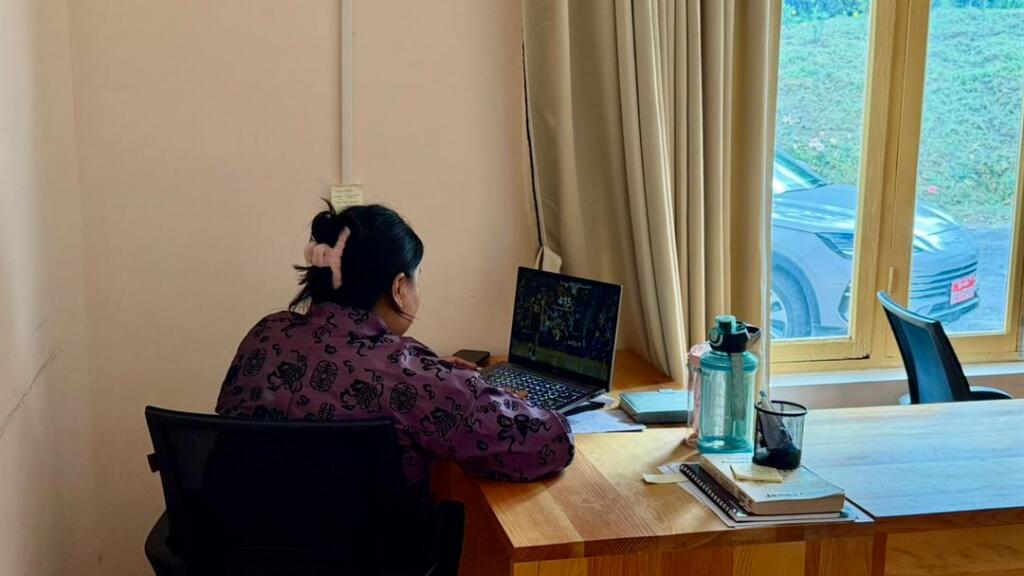
Tenzin Wangmo was a class 12 graduate when she first saw the vacancy for a matron at The PEMA Home on Facebook. At that time, she was simply looking for a job.
What caught her attention were the two words in the post “child protection”. That ignited her curiosity. A week later she applied and was selected.
“In the beginning, I thought it was a normal child care,” the 23-year-old said.
It was only after she arrived at the workplace and realised how different The PEMA Home was.
The children here, she understood, carried stories of struggle and pain. Some had experienced circumstances no child should have to navigate alone. Caring for them required more than keeping them fed, clean and safe. It required patience. Listening. Trust. And compassion.
Her first months were a learning curve. The matrons were trained and guided by the team at The PEMA Home, the helpline and other staff. Slowly, Tenzin began to understand that sometimes the smallest acts could make the biggest difference. A meal shared together or a simple “How are you?”.
The days at The PEMA Home follow a routine of school, study, meals, gardening, games, music, arts and time together. But Tenzin has learned that every child is different, and care cannot always follow a timetable.
Sometimes, the most important part of the day is simply being there.
She remembers two young children, one and three years old, who initially stayed close only to their mother and cried. Over the next three months, they started interacting with the matrons, playing in the playroom, eating with them and slowly opening up. Then they returned to their mother.
Later, when their circumstances brought them back to The PEMA Home, the children did something Tenzin has never forgotten.
“They directly gave us motherly hug.” It was a small moment. But for Tenzin, it said everything. The trust that had once taken weeks to build was now there in an instant.
“I still miss them,” she says. The children may arrive at The PEMA Home as clients, but that is not how she sees them.
“We become family and not just service provider.” And that is what makes The PEMA Home more than a place of shelter. Behind its signboard is a place where children’s health, education, emotions and everyday lives are cared for. Where counsellors are available when children struggle. Where someone thinks about the school uniform, the packed lunch, the evening meal, the difficult conversation and the quiet child sitting alone.
For Tenzin, it is a place of healing and empowerment. “The safest place,” she says. “I would dare say safer than our own homes.”
The purpose, she believes, is not simply to care for children today, but to prepare them for the life ahead.
“His Majesty The King said youths are our future. And through The PEMA Home, Her Majesty The Gyaltsuen is ensuring that no youth is left behind.”
And that is the hope at the heart of The PEMA Home, that a difficult beginning does not have to determine the rest of a child’s story.
Tenzin came looking for a job. Instead, she found a family to care for, and a place where, every day, care is quietly helping children believe in a future again.
Note: Story shared with person’s consent. Mental health and wellbeing are best understood through the experiences of people. By sharing their authentic voices, our new series, Story of Hope, humbly attempts to increase public awareness and improve mental health literacy.
If you or someone you know is struggling with substance use, you are not alone. Reach out to us at 1098